

Netherlands
 Photo: J M Rosenthal/SNS Used by permission |
In mid-November Dutch television broadcasts the official entry into the Netherlands of St. Nicholas and his helper Zwarte Piet live to the nation. Coming by steamer from Spain, each year they dock in the harbor of a different city or village. Wearing traditional bishop's robes, Sinterklaas rides into town on a white horse to be greeted by the mayor. A motorcade and a brass band begin a great parade which leads Sinterklaas and his Piets through the town.
Nearly every city, town and village has its own Sinterklaas parade. He usually arrives by horseback, but occasionally he comes by boat, carriage, moped, or helicopter.
 |
In the following weeks before St. Nicholas Day, December 6, Sinterklaas goes about the country to determine if the children have been well-behaved. He and his Zwarte Piet helpers visit children in schools, hospitals, department stores, and even at home. Bakeries are busy making speculaas, molded spice cookies, for the season.

Photo: J M Rosenthal/SNS, used by permission
During this time children sing Sinterklaas songs and put their shoes next to the window or door, or, by the fireplace or heater, along with a nice drawing, a wish-list and a carrot or hay, and maybe a saucer of water, for the horse. If St. Nicholas happens by while checking on their behavior, the next morning children may find chocolate coins or initial letter, candy treats, pepernoten, and little gifts in their shoes. Everyone hopes for sweets, not coal, a potato, a roe, or a little bag of salt, though that is no longer common. In some families he may stop by every night, but usually just once or several times—and not if the children have been naughty that day or forgot to sing their songs!
Tangerines are also an important part of the feast—major grocer Albert Heijn sells around 18 million tangerines, in eight varieties, during the week of December 5. They were first imported in the early 1800s, becoming the "apples of orange" from Spain and came to represent the gold St. Nicholas had given to the poor girls.

Photo: Juliëtte Sterkens, used by permission
Until the 1940s Dutch children found their Sinterklaas present in their shoes on the morning of December 6, the traditional and official liturgical St. Nicholas Day. Then the popular observance shifted to partying on the Eve of St. Nicholas Day, known as pakjesaavond or packages evening.
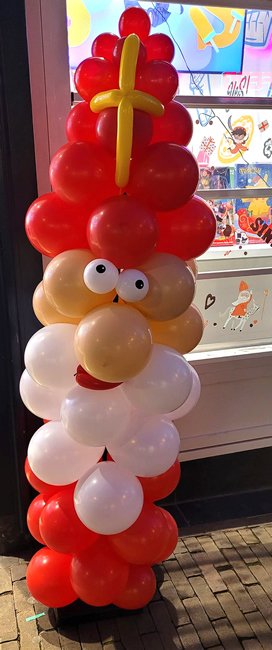 Photo: Marcus Vankan Used by permission |
The Dutch now celebrate Sinterklaas on December 5th, St. Nicholas Eve, with festive family parties when gifts and surprises are exchanged. If the 5th falls on a school day, schools close at midday, allowing children's happy anticipation of the evening's activities. In the Netherlands, unlike other places, adults as well as children join in the fun. As the Dutch like an element of surprise, a small gift may be wrapped in a huge box, or it may be hidden and require following clues to discover where it is.
Gifts are prettily wrapped in special Sinterklaas paper or they may be hidden, for example, in a potato or an old sock. Each gift, anonymously signed "from Sinterklaas," comes with a clever rhyme that may point out a person's shortcomings in a humorous way. (For the less creative, there are books with suggestions for making rhymes and packaging disguises—or Google & Pinterest, of course.) Originality, not value of the gift, is what counts. There may also be agreement on how much to spend on the presents. Primary school pupils may also be required to make one of these disguised gifts, called surprises, for a classmate. This competitive, just like the family "surprises" are.
Children sing traditional Sinterklaas songs while waiting for the saint to appear. A knock comes on the door and a black gloved hand appears to toss candies and pepernoten inside. Children scramble to gather up the treats. A large burlap bag, "de zak van Sinterklaas," also appears filled with gifts. At the table, decorated with speculaas and other sweets, guests may find their initial in a chocolate letter at their places. Food is apt to include hot chocolate, Bishop's wine, and letter banket.
 St Nicholas Center Collection |  St Nicholas Center Collection |
 St Nicholas Center Collection |
The Dutch feast of Saint Nicholas is about giving, for "it is in giving that we receive." The fun is in trying to surprise people, to tease in a well-meaning way, to make a good joke, to produce a rollicking rhyme. The gift itself is just a bonus, as the fun is in the doing.
Sinterklaas is the most important tradition for the Dutch, a 2008 Centre for Dutch Culture survey found. Celebrated the evening of December 5 with traditional tasty foods, it is the main time for family gift-giving. The second ranked tradition is decorating a Christmas tree, followed by Queen's Day, April 30 (now King's Day, April 27). Blowing out birthday candles and eating raw herring were also in the top ten. In 2023 an ABN AMBRO survey found 52%, up 4%, would celebrate Sinterklaas and 89% would buy Sinterklaas presents compared to 69% for Christmas gifts.
 Photo: Frank van Schie, used by permission |
Dutch Sinterklaas Surprises
These are no ordinary presents!
Sinterklaas Comes to Texel
Sinterklaas—One Family's Experience
Living in the Netherlands, emigrating to the USA
Who is (Zwarte) Piet? A Continuing Evolution
Six to Eight Black Men by David Sedaris
An American humorist tries to understand Dutch Sinterklaas traditions
Dutch Chocolate Letters
a special unique tradition
Sinterklaas Goes Green! De Groene Sint
how the Green Sint changed chocolate
Deventer—A Unique Sinterklaas Tradition
Saintly and Generous: Saint Nicholas and the Low Countries
How Sinterklaas traditions developed
"Sinter Claes" in Amsterdam
The iconic stone tablet in Dam Square
American G.I.s Assist Sinterklaas
A true story from World War II
Sinterklaas in Amsterdam — 1941 & 1945
During and after Nazi occupation
Sinterklaas Exhibits & Museums
in the Netherlands
Sinterklaas op bezoek
2010 Exhibit at Museum Catharijneconvent Utrecht
Sketch Sint Nicolaaskerk
Amsterdam
More in other sections
Sinterklaas Official National Entry—with Photos
2023: Official National Entry, Saturday, November 18, will be telecast live on Dutch national television.
Sinterklaas Arrival in Amsterdam
usually the day after the official arrival
More Sinterklaas Visits in the Netherlands
See Sinterklaas in more places
St. Nicholas Monuments in the Netherlands
Statues and images in public places
Airplanes, not by Steamboat
The RAF plays Sinterklaas
Rescuing Sinterklaas from Santa Claus
in the Netherlands
Amsterdam Church Receives St Nicholas Relic
gift from Egmond Abbey
Links
An interesting Dutch Sinterklaas site, with information and many images
Dutch Sinterklaas Wrapping Paper, featuring Madelein Duijvestijn's collection of more than 4700 giftwraps
Inburgerings with Dutch News: Sinterklaas and December 5: Lesson 34
Complete introduction to the Sinterklaas tradition for immigrants to the Netherlands
sinterklaasfan.nl, an introduction to the Dutch tradition that does not acknowledge the changes to the Piet figure