

Sermon on the Feast of Saint Nicholas
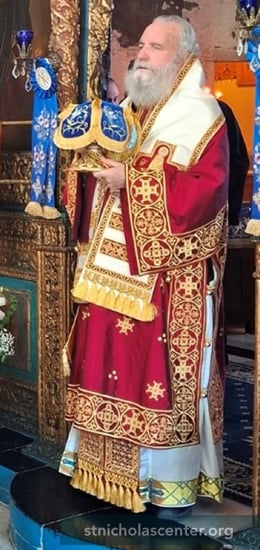
by the Patriarch of Jerusalem, Theophilos
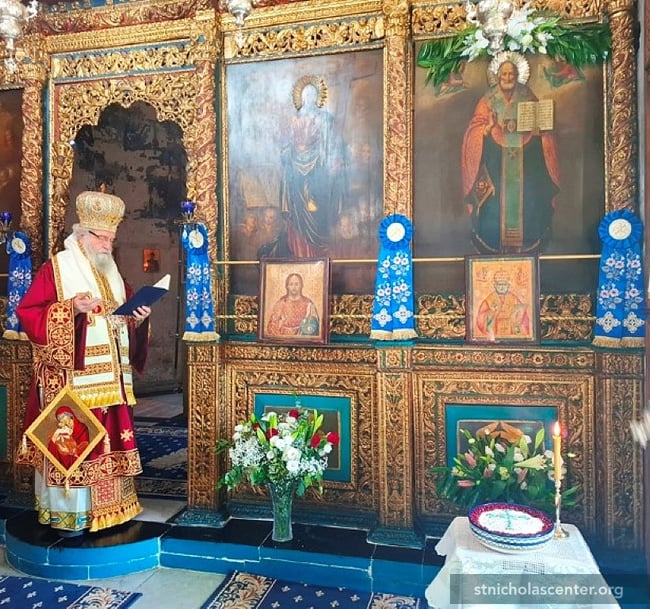 |
Saint Nicholas Church, Beit Jala, Palestine
December 19, 2025
 |
A most fervent protector of the Church of Christ wast thou shown to be, O Nicholas, boldly dissolving the godless doctrines of the heresies; thou wast revealed as a rule of Orthodoxy for all, interceding for all who follow thy divine teachings and exhortations," the hymnographer of the Church proclaims.
Beloved brethren in Christ,
Devout Christians and pilgrims
The grace of the Holy Spirit has gathered us all today in the biblical city of Palestine, Beit Jala, that we may festively honour the memory of our Father among the Saints and protector, Nicholas, Bishop of Myra in Lycia, the Wonderworker.
Our Father Nicholas, who adorned his life according to God, was born in Patara of Lycia and took part in the First Ecumenical Council at Nicaea in the year 325 A.D., at the invitation of the pious Emperor of the Romans, Constantine the Great. There, speaking with apostolic boldness, he confounded Arius and utterly overthrew his heretical teaching. For this cause, he was rightly proclaimed a protector of the Church and a rule of sound Orthodox doctrine and faith.
This faithful Hierarch of Christ became perfect in love and perfect in every virtue, hearkening to the evangelical word of the Lord: "Be ye therefore perfect, even as your Father which is in heaven is perfect" (Matt. 5:48). Interpreting this divine command, Saint Athanasius the Great declares: "For even we, though we cannot become like God in essence, yet by improvement through virtue we imitate God. That created beings are changeable, none would deny, since angels transgressed, Adam disobeyed, and all need the grace of God. That which is changeable cannot be like the unchangeable God, just as the created cannot be like the Creator."
Thus, the God-bearing Nicholas was revealed as a rule of all Orthodoxy, precisely because he became an imitator of God through the virtues. "Blessed are they that keep judgment and do righteousness at all times" (Ps. 105:3); and "The righteous shall flourish like the palm tree; he shall grow like a cedar in Lebanon" (Ps. 91:13), cries the Psalmist.
Commenting on this Davidic utterance, Saint Cyril of Alexandria states: "The palm tree is an evergreen plant, deep-rooted and lofty, fruitful, fragrant, and sweet in its fruit. Such are all those who possess righteousness in Christ."
This righteousness in Christ, Saint Nicholas made his own, proclaiming Christ, the Saviour of the world, both in word and in deed, hearkening to the voice of the Psalmist: "Declare His salvation from day to day; proclaim His glory among the nations, His wonders among all peoples" (Ps. 95:2–3).
The "salvation of the Lord" is none other than the God the Word, who from the pure blood of the Ever-Virgin Mary and by the overshadowing of the Holy Spirit was incarnate and became man in the humble Cave of Bethlehem, in the days of Caesar Augustus, when Quirinius was governor of Syria (Luke 2:1–2). His wonders—that is, the works of the Lord—are, according to the divinely inspired Paul, the grace given to us "in Christ Jesus before the world began, but now made manifest by the appearing of our Saviour Jesus Christ, who hath abolished death and brought life and immortality to light through the Gospel" (2 Tim. 1:9–10).
Of this grace given to us in Christ Jesus, the most holy Nicholas was revealed to be a faithful steward, as the hymnographer most clearly proclaims: "Filled with the beauties of the invisible, thou didst perceive that fearful glory, O Holy of Holies; wherefore thou proclaimest to us the heavenly words of those ever-living contemplations, O most sacred one."
It is to partake of this very grace, beloved brethren, that our God-bearing Father Nicholas now calls us, as we draw near to the Metropolis of feasts—the holy Nativity—this supra-natural and supra-rational mystery, concerning which the hymnographer, struck with awe, cries aloud:
"How was He, whom nothing can contain, contained in a womb? How was He who is in the bosom of the Father held in the arms of a Mother? Surely as He knew, as He willed, and as He was pleased. For being incorporeal, He willingly took flesh; and He who is became what He was not for our sake; and without departing from His nature, He partook of our substance. Christ is born twofold, desiring to fill the world above."
The Son and Word of God, and Son of the Virgin Mary, who partook of our human nature through the Holy Spirit, has made us temples of the living God, as the wise Paul proclaims: "For ye are the temple of the living God; as God hath said, I will dwell in them and walk in them; and I will be their God, and they shall be My people" (2 Cor. 6:16; Lev. 26:12).
Here the blessed Apostle not only reminds us that we are temples of the living God, but also shows us the path by which we may ourselves become the Cave of Christ’s Nativity—that is, the Temple of the Holy Spirit, the Spirit of Christ: "Let us cleanse ourselves from all filthiness of the flesh and spirit, perfecting holiness in the fear of God" (2 Cor. 7:1). According to the commentator Zigabenos, "the phrase in the fear of God explains the manner in which holiness is perfected."
Behold then, beloved brethren, the manner by which our Father Nicholas, whom we honour today, exhorts us—through the voice of the Apostle Paul—to magnify the King born in the flesh from the Virgin in the Cave of Bethlehem. In other words, the sanctification of our souls and bodies constitutes a necessary condition for every faithful Christian who desires to celebrate spiritually—and not merely materially, that is, in a worldly or social manner—the great and saving mystery of the Nativity of our God and Saviour Jesus Christ.
Therefore, all of us who honour the sacred memory of our Father among the Saints, Nicholas, Bishop of Myra in Lycia, the Wonderworker, let us fervently entreat him and say with the hymnographer: "Having appeared as a most excellent physician of every grievous disease, O Father Nicholas, heal the infirmity of my soul and grant me strength to cry aloud: Blessed is the God of the Fathers."
Amen. Blessed Christmas, and "Glory to God in the highest, and on earth peace, goodwill toward men" (Luke 2:14).
By the Patriarch of Jerusalem, Theophilos, Jerusalem Patriarchate, December 19, 2025, permitted use with attribution and link.