

What if we were more like St. Nicholas?
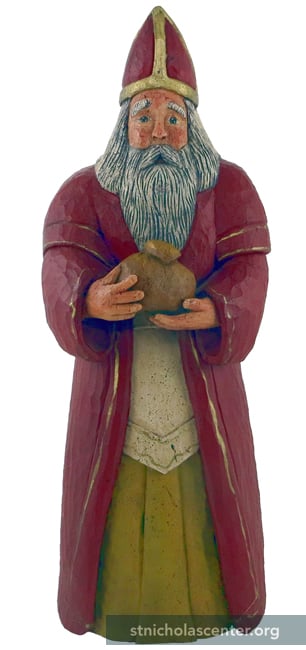 |
By Furman Buchanan
Less than 300 years after the birth of Jesus in Bethlehem, a child was born somewhere along the eastern rim of the Mediterranean Sea in Asia Minor, what is now known as the Republic of Turkey. We don’t know much about his childhood, just as we don’t know much about the childhood of Jesus.
What we do know is that as a young man, Nicholas dedicated himself to following in the way of Jesus. We also know that his dedication to Jesus led to some similar outcomes under the repressive Roman government. Like Jesus, Nicholas was imprisoned and tortured. Fortunately, he avoided public execution at a young age.
Nicholas became a leader in the church. He likely attended an important council in Nicaea in 325 A.D. that continues to shape the way faithful Christians think and talk about Jesus to this day. Yet, the most interesting stories and legends about Bishop Nicholas are not the ones about his thoughts and words. The most impressive memories we have are his deeds of mercy, particularly the loving acts he performed secretly.
According to one story, he once sailed on an Egyptian ship to the Holy Land, anonymously taking his place among the other pilgrims and seafarers. A terrible storm developed in the midst of their voyage. Nicholas prayed for the tempest to be calmed, and it was. He even revived a sailor who appeared to have been killed in the midst of the violent weather.
An even more popular story describes how Nicholas once placed gold coins into stockings, drying by the fireplace, of three poor children. These three daughters, whose father could not afford to pay a single marriage dowry, were at risk of being abandoned to a life of misery. Essentially, Nicholas saved these vulnerable girls from a life of poverty and prostitution.
As a result of his deeds, Bishop Nicholas eventually became celebrated as Saint Nicholas on Dec. 6. It is easy to see how Nicholas became such a popular patron saint of sailors and children. It is also easy to see how — for more than 1,500 years — adults all over the world have emulated his ways for the sake of their own children.
What may not be as easy to see is how we are also called by St. Nicholas’ example to respond to people in desperate need. When we see faithful, hard-working families being torn apart by an immigration crackdown supposedly aimed at violent criminals, are we inspired by St. Nicholas to act mercifully and generously? When we see impoverished children in our own nation — even in our own city — who are at risk of living unhealthy, unsafe and marginalized lives, are we inspired by St. Nicholas to act mercifully and generously?
The blessed legacy of St. Nicholas is alive and well in the 21st century insofar as we devote a lot of time, energy and money to giving amazing gifts — secretly and not-so-secretly — to those we love. Indeed, it is a good thing to give gifts to those we love. It is just not the only thing.
Looking more carefully at the life of St. Nicholas, we see that his deeds were not just aimed for the happiness of his own family. The reason Nicholas became famous is because of all that he did for the most poor and vulnerable.
During this season of goodwill, I invite you to imagine yourself as St. Nicholas. Take a moment to pretend what you might do to be like him. What act of mercy for someone in danger might you be suited to perform anonymously? What gifts of mercy for a child in need might you be suited to give in secret?
With a little imagination and generosity, we can do more than pretend to be like St. Nicholas, we can actually be like him — quietly showing mercy for those who are poor and vulnerable in our midst.
By the Rev. Furman Buchanan, rector,