

Two Medieval Russian Icons from Novgorod
by George Mitrevski, Professor Emeritus, Auburn University
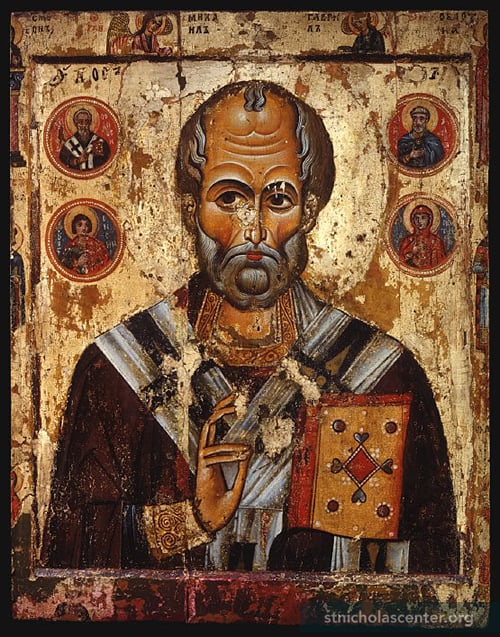 |
This rendition of St. Nicholas Novgorod, painted on limewood boards, is one of the extremely rare surviving works of the mid-thirteenth century. It reflects the Byzantine tradition which came to Novgorod via southern Kiev, Russia's first capital and cultural center.
The Hetimasia in the upper border, though damaged, is flanked by the Archangels Michael and Gabriel. On the side borders can be seen Symeon Stylites, Prince Boris and Prince Gleb, Eudoxia and an unknown woman martyr and Florus the Martyr.
The round medallions represent St. Athanasius of Alexandria, Onesimus the Martyr, the Apostle Jude(?) and Catherine the Martyr.
The history of Novgorod, one of the oldest Russian towns, spans eleven centuries. Having escaped the Mongol invasion of the early thirteenth century, it became an important center of learning and painting, and spearheaded the cultural revival of the fourteenth century. During this time it preserved the Byzantine traditions that constituted the core of Russian art. The city, though located on the great Russian plain, was linked via deep rivers and lakes to the Black, Baltic, Caspian, and White Seas. Accordingly, Novgorod became one of the greatest trading centers of eastern Europe, supporting commerce which exceeded that of Genoa or Venice. Constantinople had close ties with the city and there were Novgorodian translators and manuscript transcribers living in Constantinople. Artworks from Byzantium, Scandinavia, the Caucasus and Central Asia were brought to the city.
Novgorodian painting constitutes a particularly celebrated aspect of old Russian art and Novgorodian icons are highly treasured by institutions fortunate enough to include them in their holdings.
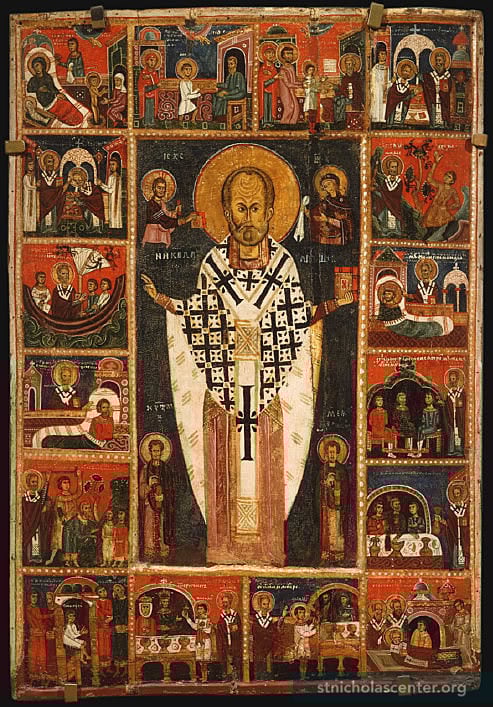 |
Novgorod "St. Nicholas with Scenes from his Life" features the saint with half-figures of Christ to the left of his head and the Mother of God to the right.
Below their representations respectively are the brothers Kosmas and Damian whose cult was also associated with Novgorod. Beginning at the upper left corner and continuing to the right and around the panel as a border are sixteen scenes from the life of the saint.
St. Nicholas was the celebrated Bishop of Myra in Lycia whose reputation as a wonder-worker brought him centuries of unequaled veneration in Russia. The cult of Nicholas was established after Russia's conversion to Orthodoxy in 988. Indeed, the worship of Nicholas was so ubiquitous that by the seventeenth century his name had become synonymous with the word "icon," which foreign visitors often referred to as "a Nicholas." Nowhere else in the country was worship of Nicholas more intense than at Novgorod.
It is not surprising that this icon, though of good size and striking in its complexity, is one of many from the region detailing aspects of the holy man's legend. Few works have been preserved from this early period, however, and this icon is therefore of considerable rarity despite its rather common subject. Stylistically and paleographically, this work is related to thirteenth century examples.
Painted on a limewood panel in three pieces, the large central figure of St. Nicholas takes the so-called "orans" posture, one associated through an earlier icon of the saint with the power to defend cities from attack. This earlier icon had been brought from the Greek colony of Cherson in 1255, kept for a time in Novgorod, then brought to Zarazsk, near Riazan. At Novgorod, it became associated with miracles.
The stance of the saint in the icon illustrated here has come to define the figure referred to as St. Nicholas of Zarazsk. The tale of this saint recalls how his icon brought Novgorod through the Tartar invasion unscathed.
From George Mitrevski, Professor Emeritus, Auburn University, Pelister, used by permission.