

Scientific documents on the nature of Manna
Scientific Documents on the Nature of the Manna of St Nicholas
from the Basilica Pontificia San Nicola, Bari, Italy
General Chemistry Laboratory, University of Bari, Bari, July 4, 1925
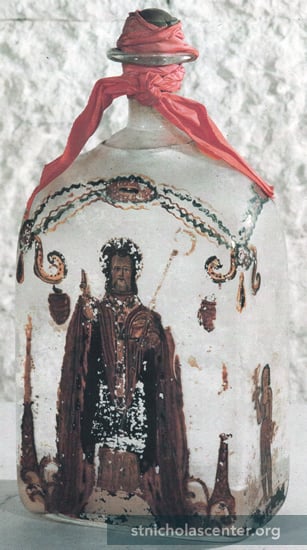 Photo: Elio Sciacovelli |
From the Most Reverend Dominican Father Pio Scognamiglio, I had two samples of the Manna of St. Nicholas examined. One bore the inscription: "Manna of 1925" and the other "Manna of 1910". I was also given some external water that sometimes collects during high tide or due to rain infiltration into the Church. The latter was a cloudy, yellow-brown water that, when filtered, contained a fixed residue of gr. 1.038 per litre. Given the small quantity of Manna obtained, I limited my examination to the fixed residue of the Manna and its density. The results obtained are the following: Manna 1925
- density at 12° gr. 1.0013 per litre
- fixed residue gr. 0.048 per litre
As can be seen, it is almost pure water and has no relation with, so to speak, external water.
The Manna of 1910 gave very similar numbers:
- density at 12° gr. 1.000 per litre
- fixed residue gr. 0.04 per litre
From the data obtained it can be stated:
The Manna of St. Nicholas is an almost pure water that is not related to the infiltration waters of the environment outside the ark of the Saint.
—Prof. Ricardo Ciusa
R. University of Bari Institute of Hygiene
Bari. July 18, 1925.
Most Reverend Father Pio Scognamiglio
Superior of the Dominicans
Convent of St. Francis, Bari.
I have the honor of reporting to Your Reverence the results of the quantitative and qualitative bacteriological examination, performed on the samples of the Sacred Manna of St. Nicholas, collected, at your request, on the 8th and 12th of the current month.
At the time of the sampling, I saw a small quantity of Manna collected at the bottom of the urn, which did not reach the level of the liquid on the bones above.
Between one sampling and the next, the urn remains sealed.
The sampling is performed by aspiration using a sterile pipette attached to a rubber tube, and by absorption using a sterile sponge.
With the small quantity (a few cmc.) of manna collected, I performed the determination of the microbial content and the search for Bacterium coli.
From one cmc. of manna seeded on agar and gelatin plates, approximately 50 colonies of schizomycetes developed, belonging to only two species, one represented by Bacillus liquefaciens nonfluorescens, and the other by a bacillus that does not melt gelatin, but does not ferment glucose and therefore does not belong to the coli group. No colonies of hyphomycetes developed.
Manna seeded in quantities of 2 cmc. in fermentation tubes containing glucose, kept for 48 hours at 37°C, did not produce gas; therefore, the presence of Bacterium coli must be ruled out.
The low bacterial count found, the extremely limited number of schizomycete species, and the absence of Bacterium coli are, for groundwater, indications of biological purity.
Based on these results, it must be assumed that the Sacred Manna of St. Nicholas is formed and collected under conditions that exclude any contamination of surface water.
Prof. Filippo Neri
Director of the Institute of Hygiene at the Royal University of Bari.
Royal University of Bari
Institute of Hygiene
Bari, 20 July 1925
Most Reverend Padre Pio Scognamiglio
Superior of the Dominicans
Convent of St. Francis, Bari
In response to what I reported to you the day before yesterday regarding the bacteriological examination of the Sacred Manna of St. Nicholas , I can add that a fixed residue (40 mg. per litre) as low as that found by Prof. Ciusa in the same Manna is exceptional for underground waters. The fixed residue of these waters varies within very wide limits, depending on the nature of the soil; but it is rarely less than 100 mg. per litre.
In the treatises and monographs available to me, I have never found a residue lower than 50 mg. per litre for these waters. These low residues are typical of waters that collect in siliceous soils, after flowing through a topsoil poor in decomposing organic matter.
Residues even lower than 40 mg per liter are frequently found in surface waters, especially those flowing over compact, poorly soluble siliceous soils, and in alpine soils fed by melting glaciers.
With
sincere respects,
Prof. Filippo Neri
Manna of Saint Nicholas
Manna or Myron
"Manna" in the most ancient Greek testimonies
In another section
Prayers for the Administration of Saint Nicholas Manna
Links
Short clip, also from www.st-nicholas.tv
The "Documenti scientifici sulla natura della Manna," Basilica Pontificia San Nicola, Bari, Italy. Used by permission